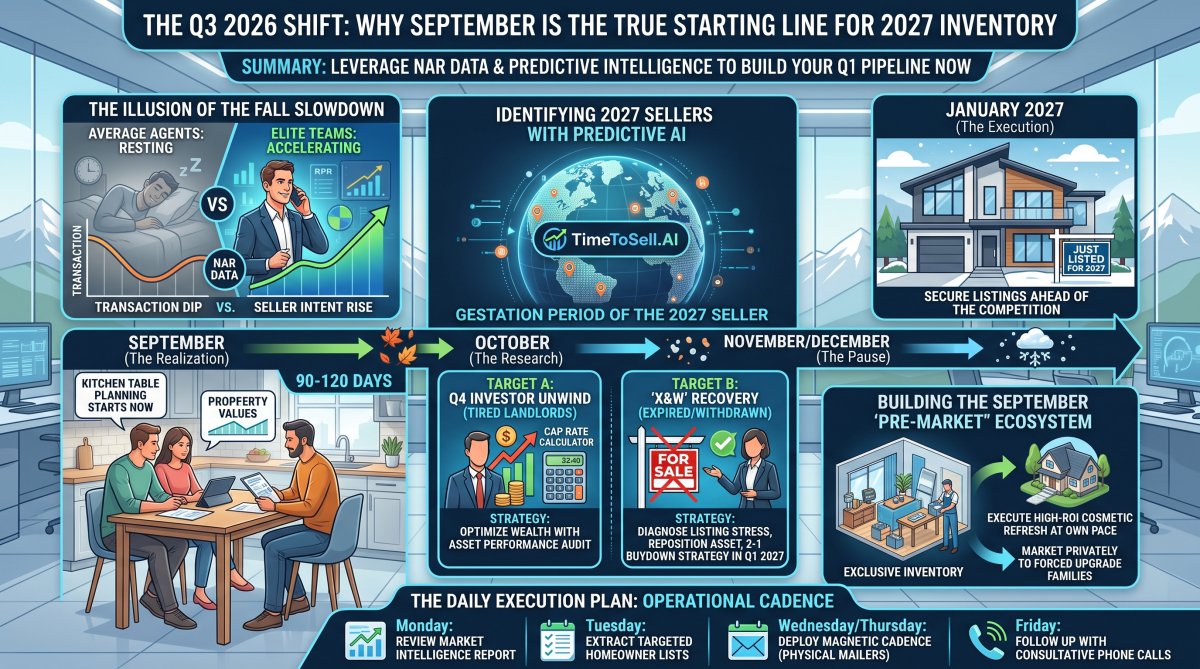
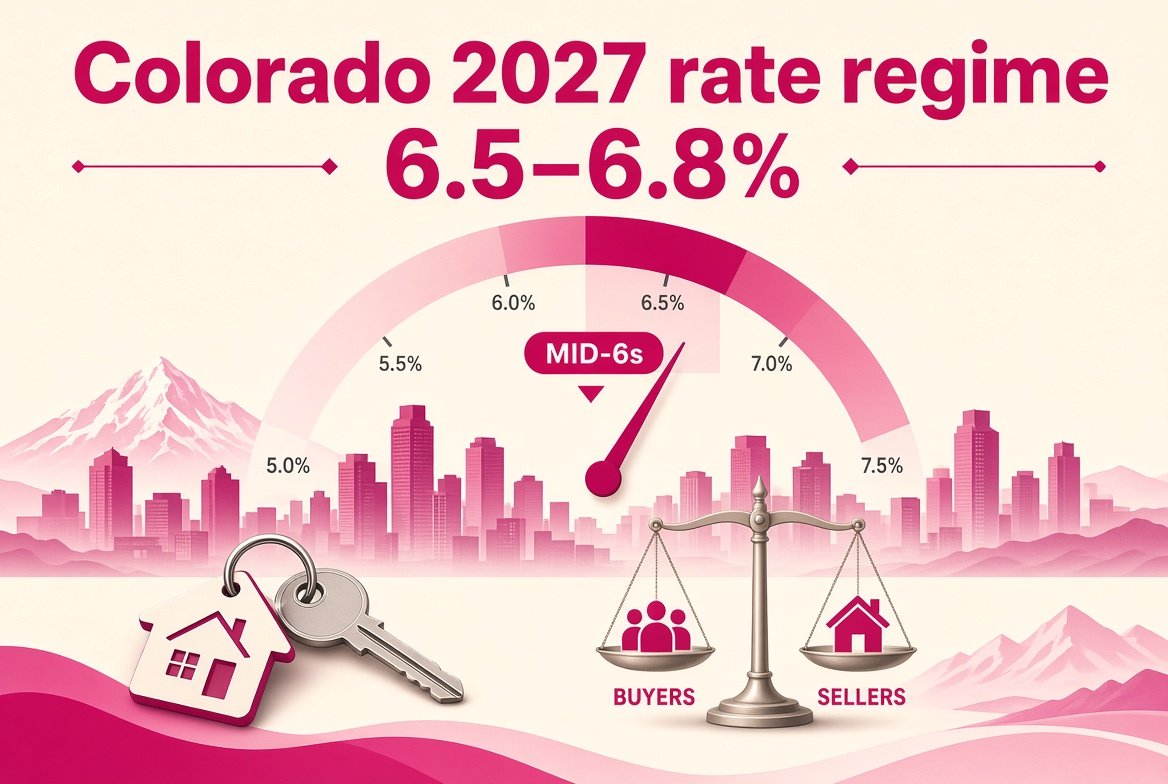
Stop waiting for 5% money. The working band for 2027 planning is 6.5–6.8% on a 30-year fixed. National sales are stable and dull. Colorado listings still happen—just not to people who only move when the note gets cheap. This is the climate the Playbook is written for.

The national tape, late August 2026
Freddie Mac’s Primary Mortgage Market Survey put the 30-year at 6.65% for the week ending 20 August 2026 (FRED series MORTGAGE30US). MBA’s survey sat a little higher, near 6.78%. Through the summer the band was roughly 6.43% to 6.69%. That is not a spike. That is a parking lot.
NAR’s July existing-home sales: 4.06 million seasonally adjusted annual rate, down 1.7% from June, up 0.7% from a year earlier. Year-to-date sales were up 2.4%. Lawrence Yun’s line is the one to keep: sales have been “remarkably stable” in a rising-rate tape, and the market would thrive if average mortgage rates returned near 6%. They have not.
Median existing price in July: $434,100, up 2.0% year over year—the 37th consecutive annual increase. June had printed a record $440,600. Inventory: 1.54 million units, 4.6 months of supply. Pending home sales in July fell 2.3% month over month and 2.2% year over year, weakest since January, with the West the softest region. Housing starts dropped 12.4% in July. New supply will not rescue the fall tape.
Affordability is less awful than the sticker suggests. NAR’s housing affordability index improved year over year because wages outpaced prices. The payment is still the binding constraint. Insurance, taxes, and HOA dues do the rest—especially in Colorado.
Lock-in is a 2027 fact, not a 2023 headline
The owners who bought or refinanced at 3–4% in 2020–22 are still on those notes. They do not list because a flyer arrived. They list because a life event overpowers the payment shock of a new 6.6% loan: a death, a divorce, a job, a house that no longer fits, an insurance non-renewal, a rental that stopped being a hobby.
That is why TimeToSell does not sell “more names.” It sells ranked motivation on a territory you actually own. The locked-in owner is invisible to a portal lead and obvious once you look at tenure, equity, layout, and insurance risk together. The older field guide still holds: the locked-in effect. The climate around it has hardened, not thawed.
Colorado is balanced. It is not one market.
Denver-metro mid-year reads from CAR and DMAR rhyme. 2025 was the high-inventory year. 2026 inventory came down from that peak—CAR had Denver-metro June actives down the mid-teens year over year—but the street is still far from 2021 scarcity. Sale-to-list sits around 99%. Days on market are a working number, not a weekend.
The split that agents keep flattening:
- Detached single-family — fewer months of supply, prices holding or up a little. Clean, well-priced SFH still trades.
- Condos and townhomes — more months of supply, medians off the 2022 peak by roughly a tenth in some cuts, longer DOM.
Price them as two books. The long version is SFH vs attached on the Front Range.
Northern Colorado and selected metro corridors still print listing-stress clusters on TimeToSell Market Intelligence: reattempts, time-on-market warnings, pullbacks before withdrawal. That is the tape to farm, not a memory of multiple offers.
How to operate inside 6.5–6.8%
If you build a 2027 business plan that requires 5.5% money, you will sit on your hands. If you build one that assumes 2021 urgency, you will overprice your listings and under-work your farm.
- List to the payment, not the ego. A 2-1 buydown often does more than a raw price cut. Keep the concession menu in the CMA, not in a drawer.
- Talk to financed buyers without apology. Cash is no longer king. Details: the cash briefing.
- Work life-event inventory. Downsizers, heirs, uninsurable owners, tired landlords. The Playbook’s sixteen profiles were built for this regime.
- Own geography. A shared Zillow name at 6.6% is a knife fight. An exclusive seat is a desk. Browse Open Slots.
Where TimeToSell sits
TimeToSell is a Colorado listing-advantage layer. It does not replace your CRM or your brokerage OS. It tells you which owners on your streets have a reason to talk, and it keeps the seat exclusive while it is On.
Free layer: daily Market Intelligence — including the X&W clusters you should read before you write a farm letter. Paid layer: Territory Farm + Priority List in /app, with email and in-app alerts when a score band moves. How to work it: The Proactive Agent’s Playbook, 2027 edition and For agents.
When offered, use COLORADO-100 on the first Open Slot. The rate regime will not gift you a listing. A ranked list on a street you own still can.
What “stable” hides on the ground
National existing-home sales near four million feel like a shrug after 2021. They are not a shrug for an agent who lists two homes a month. A 1.7% monthly dip is a listing that closed next month instead of this month. A pending-sales drop in the West is a contract that never went hard. Plan capacity for a grind, not for a surge that requires 6.0% money Yun himself does not see on the tape.
Housing starts falling 12.4% in July is the supply tell. Builders are not about to flood Front Range SFH streets and rescue affordability. Multifamily can still deliver apartments; that pressure shows up in the attached book and in the rent-vs-buy conversation, not in a sudden wave of $650,000 resale inventory.
Use FRED the way a serious desk does. Watch MORTGAGE30US weekly. If the 30-year tags 6.9%, pause new list-price experiments and lean harder into buydowns. If it tags 6.3%, you will see a pulse in pendings with a lag. Do not rebuild your value proposition each time. Rebuild the net sheet.
The 2026 outlook post remains up as an archive. Cite this briefing when you need the current band. Cite the Playbook when you need the system. Cite Market Intelligence when you need this week’s zip.
For teams: put the rate band on the Monday huddle whiteboard. Not a forecast. A constraint. “We are in 6.5–6.8%. Who on our farms has a life reason to sell inside that constraint?” That question is the whole product.