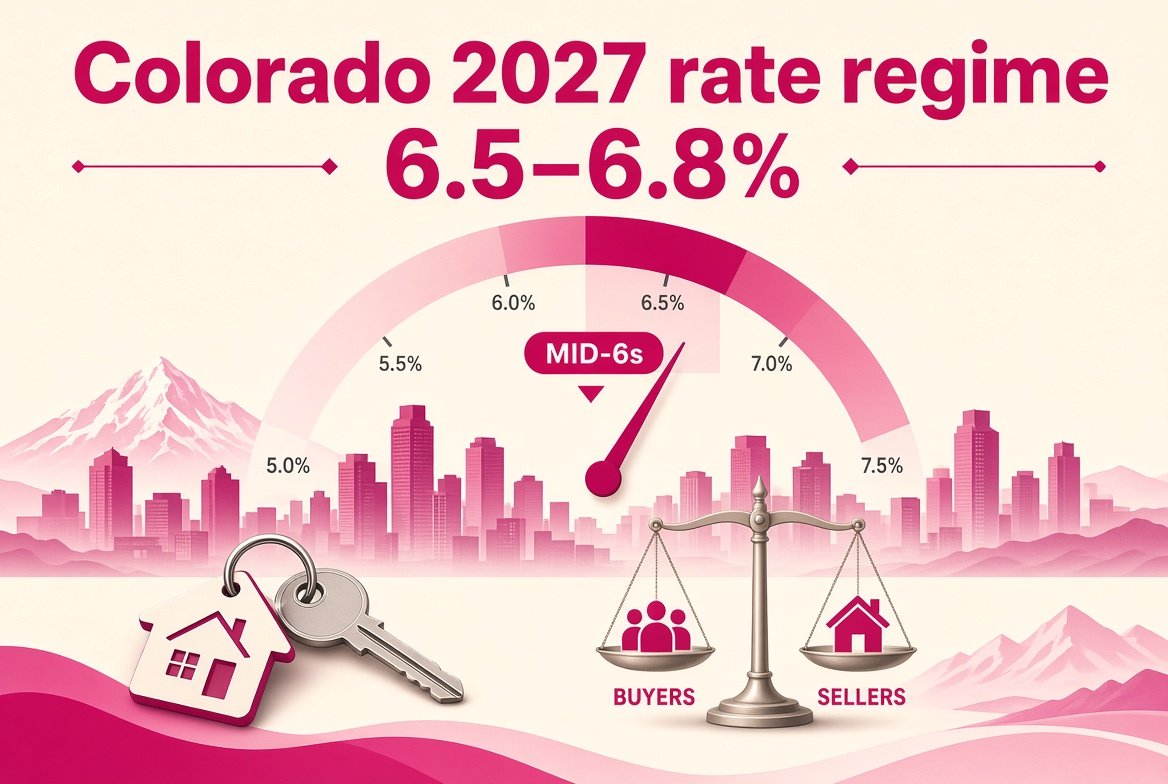

Interest rates remain the single largest external variable shaping Colorado’s housing market. Yet rates themselves are not destiny. What matters is how different owner and buyer profiles respond to each plausible rate path between now and 2029. Agents who understand the mapping between rate scenarios and profile behavior will allocate their time and capital far more effectively than those who treat “rates” as a single binary force.
This article lays out three coherent rate scenarios for 2027–2029, the seller and buyer profiles that activate under each, and the practical implications for Colorado agents who want to stay ahead of the curve. It draws on the same predictive framework that powers TimeToSell’s seller and buyer intelligence and the free Market Intelligence reports published daily and weekly.
Scenario Framework
We deliberately avoid single-point forecasts. Instead we define three internally consistent worlds:
- Base Case — Gradual Normalization: Mortgage rates drift into the mid-to-high 5% range by late 2027 and stabilize near 5.0–5.5% through 2028–2029. Inflation is contained without a deep recession.
- Faster Easing: Rates fall into the low 5% or high 4% range by mid-to-late 2027. Growth slows enough for the Fed to ease more aggressively, or inflation surprises to the downside.
- Sticky Higher Rates: Rates remain in the 6%+ range through most of 2027 and only ease modestly in 2028. Inflation proves more persistent or fiscal concerns keep term premiums elevated.
Each scenario produces a different mix of listing volume, price behavior, and dominant seller/buyer profiles. The agents who win will be those who can recognize which scenario is unfolding in real time and adjust their prospecting and pricing advice accordingly.
Base Case: Gradual Normalization
In the most probable path, the locked-in effect softens but does not disappear. Pure rate-driven sellers remain cautious. The profiles that list earlier and more willingly are those with non-rate motivations strong enough to overcome a still-elevated payment differential.
Seller profiles that activate first
- Trapped Equity Downsizers — Substantial equity, lower remaining balances, lifestyle pressure from empty nests or maintenance burden.
- Life-Event Executors — Divorce, death, job moves, health. These listings are relatively rate-inelastic.
- Insurance / Climate Forced — Mountain and wildfire-adjacent communities where non-renewal or premium spikes force decisions independent of the mortgage rate.
- Selective HELOC Squeeze — Owners whose variable second liens have become painful and who prefer to sell rather than continue the cash-flow strain.
Buyer profiles that gain strength
- Trade-up families with strong equity positions who can absorb a moderate payment increase in exchange for space or school quality.
- Cash or low-leverage buyers who were already less rate-sensitive.
- Investors focused on long-duration holds rather than short-term cash-flow arbitrage.
Under this scenario, overall inventory rises modestly and days-on-market normalize in most metro Denver and Front Range submarkets. Price growth remains positive but subdued. Agents who have already built relationships with the high-propensity profiles listed above will capture a larger share of the listings that do appear. The free Market Intelligence series is already highlighting geographic clusters of these profiles; exclusive Territory Farm seats convert those public signals into private, ranked Priority Lists (see Territory Farms for Agents).
Faster Easing Scenario
If rates fall more quickly into the high 4% or low 5% range, the locked-in effect weakens across a broader set of owners. Trade-up activity reaccelerates. Investors who have been waiting for a more favorable cost of capital re-enter. Listing volume rises more evenly and the market feels closer to a “normal” turnover environment.
In this world the predictive edge shifts from identifying the rare forced seller to ranking the much larger set of discretionary sellers by timing and motivation. Seller profiles that were previously secondary — pure rate-sensitive trade-ups, portfolio rotators, and equity-rich owners considering a second home or relocation — become more active. Buyer capacity scores (the ability of the local buyer pool to absorb a given price point without extreme concessions) become critical for pricing strategy. Agents who understand both the seller propensity score and the buyer capacity landscape will structure better offers and protect seller equity more effectively. For more on the buyer side of the model, see our work on Owner Profiles and capacity scoring.
Sticky Higher Rates Scenario
If rates remain elevated, the absolute number of motivated sellers shrinks. Competition for those listings intensifies. Shared lead sources become even less efficient because the same thin set of names is shopped to multiple agents. Exclusive access to a ranked Priority List inside a defined community becomes a larger relative advantage.
The dominant seller profiles under sticky rates are the highest-pressure ones: life-event forced, insurance-driven, severe cash-flow stress, and owners in micro-markets that have already experienced meaningful price corrections. Buyer profiles skew more heavily toward cash, low-leverage, and investors with longer horizons. Concession strategies and creative financing become more important, and agents who can bring data on buyer capacity to the listing presentation will win more listings and negotiate stronger outcomes.
In this environment the free daily Market Intelligence reports become especially valuable as an early-warning system for emerging stress clusters. Agents who convert those public signals into exclusive seats before the rest of the market notices will control the limited inventory that does come to market.
Cross-Scenario Implications for Colorado Agents
Regardless of which path materializes, three principles hold:
- Profile differentiation beats geography alone. Farming an entire ZIP with equal intensity is less efficient than ranking the owners inside that ZIP by propensity and profile. The Seller Profiles framework exists precisely for this purpose.
- Public signals are the top of the funnel; exclusive seats are the conversion layer. The free Market Intelligence reports surface the highest-severity trends statewide. Territory Farms convert the most relevant of those trends into a private ranked list for one agent. See how exclusive seats work and current open slots.
- Buyer intelligence is the missing half of most listing strategies. Knowing that an owner is likely to sell is only half the battle. Knowing what the local buyer pool can actually pay — and what concessions or rate-buydown structures will clear the market — determines whether the listing succeeds and how much equity the seller preserves. TimeToSell’s predictive framework covers both sides.
For practical outreach sequences matched to each major seller profile, consult the Agent Playbook. For the latest accuracy metrics on Tier-1 predictions, see the Accuracy page.
Looking Ahead to 2029
By 2029 the locked-in cohort of 2020–2022 will have aged another three years. Life-cycle pressure will have increased for a large share of those owners. Even under a sticky-rate path, the cumulative effect of aging, job changes, family formation, and insurance trends will produce more turnover than a pure rate model would suggest. The agents who have spent 2026–2028 building ranked relationships inside specific communities will be positioned to capture that volume. The agents who continued to rely on shared lists and cold geographic farming will find themselves competing harder for a still-constrained set of already-motivated sellers.
Rates will matter. Profiles and timing will matter more. The data to distinguish the two is already available.