
Executive Summary: "How is the market?" is a trick question. In March 2026, the answer depends entirely on the street, the school zone, and the specific price band. While broad Colorado stats might show a "flat" market, hyper-local pockets are seeing bidding wars while others sit stagnant. Algorithms like Zillow's Zestimate struggle with this nuance because they rely on averages. To win in 2026, agents must master Micro-Market Pricing, specifically the concept of the "Competitive Cell."
The Failure of Averages
If you look at the Denver Metro headlines for Q1 2026, you will likely see stats like "Prices Flat" or "Inventory Up 12%." If you treat your listing strategy based on these headlines, you will fail.
Averages flatten the peaks and fill in the valleys. They hide the truth. In the current market, we are seeing a massive divergence in performance:
- Hot Zones: Turnkey, single-family homes in the Cherry Creek School District under $850k are seeing 5-7 offers in the first weekend.
- Cold Zones: Dated condos in DTC or Aurora with HOAs over $400/month are sitting for 90+ days, even with price cuts.
If you price a DTC condo based on the "Denver Average," you will overprice it by 10% and chase the market down. If you price the Cherry Creek home based on the average, you will leave $50,000 on the table.
The Algorithm's Blind Spot
Automated Valuation Models (AVMs) like the Zestimate are fantastic at analyzing commodity data (square footage, bed/bath count). They are terrible at analyzing human data (condition, smell, layout flow, light, noise).
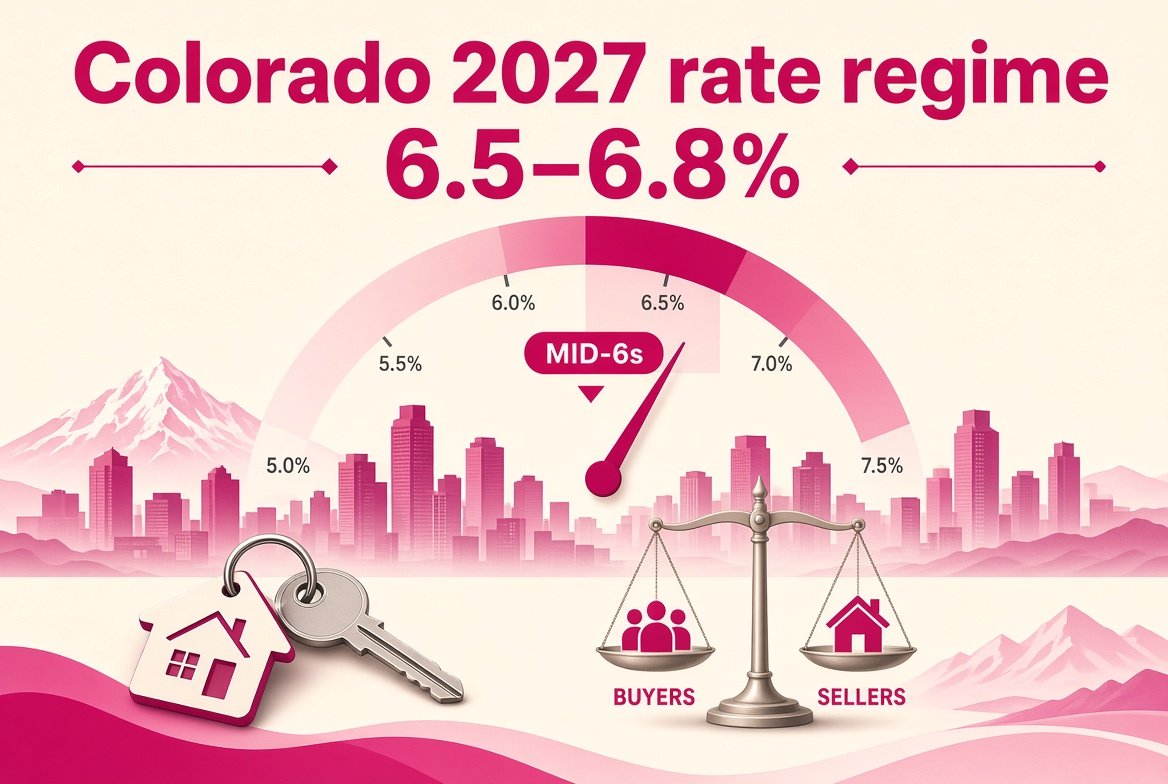
In 2026, with interest rates stabilizing in the mid-6s, buyers have become incredibly picky. They are paying premiums for "Perfect," but they are punishing "Average" severely. An AVM cannot see that the kitchen renovation from 2015 now looks dated to a 2026 buyer. It cannot see that the backyard backs up to a busy road. It only sees the zip code.
The Solution: "Competitive Cell" Analysis
To price accurately in 2026, stop looking at "Comps" (Comparables). Start looking at "Cells."
A Competitive Cell is a hyper-specific bucket of inventory that a specific buyer is looking at right now. It is defined by:
- School Zone (Not just Zip Code—parents search by elementary boundary).
- Bedroom Count (The gap between 3 and 4 bedrooms is a massive valuation cliff).
- Condition Tier (Turnkey vs. Original).
The Exercise: When you sit down with a seller, do not show them 20 homes in the neighborhood. Show them the 3 homes that are their direct enemies. Those are the only homes that matter.
Using TimeToSell.AI for Absorption Pricing
Once you define the Cell, you must analyze the Absorption Velocity. This is where predictive data beats the Zestimate.
Use your dashboard to ask two questions about the specific Cell:
- The Inflow: How many similar homes came on the market in the last 30 days?
- The Outflow: How many went pending?
The Rule of Thumb:
- If 5 came on and 4 went pending, you have Pricing Power. You can push the price 3-5% above the last sale.
- If 5 came on and 1 went pending, you have Pricing Weakness. You must undercut the last sale by 3-5% to be the one that sells.
Finding the "Pricing Cliff"
In the digital age, pricing is a search engine optimization (SEO) strategy. Buyers set filters on Zillow and Redfin. These filters create invisible Pricing Cliffs.
The $50k Increments: Most buyers search in $25k or $50k increments.
Example: A buyer searches for homes "Up to $800,000."
If you price a home at $805,000, you are invisible to that buyer. You are in a different digital bucket.
The Data Strategy: Use TimeToSell.AI to analyze demand clusters.
Scenario: You want to list at $760k.
Data: Our data shows 450 active searches in your zip code for "$700k-$750k", but only 120 searches for "$750k-$800k".
The Move: You price at $750,000. You capture 4x the eyeballs. The bidding war will likely drive the price back up to $765k, but you only got there because you respected the Cliff.
The Conversation: How to Tell the Seller
Sellers are emotionally attached to their Zestimate. They see a number online and anchor to it. Here is the script to un-anchor them using data:
Agent: "Mr. Seller, I know Zillow says your home is worth $780,000. That algorithm is looking at every sale in the zip code over the last 6 months. It's looking in the rear-view mirror."
Agent: "I am looking out the windshield. Right now, in your specific school zone, there are 4 other homes for sale. Only 1 has gone under contract in the last 30 days. That tells us buyers are hesitating. The home that sold was listed at $750,000. The ones sitting are at $775,000."
Agent: "We have a choice. We can price at $780k and help your neighbors sell their homes by looking expensive, or we can price at $750k, capture the entire buyer pool, and likely negotiate up. Which strategy do you prefer?"
Conclusion: Be the Economist, Not the Messenger
In 2021, you could put a sign in the yard and pick the highest offer. In 2026, pricing is a science. It requires analyzing micro-market absorption, respecting digital search cliffs, and ignoring broad averages.
Don't let an algorithm dictate your strategy. Use TimeToSell.AI to get the granular data that Zillow misses, and help your sellers win by pricing for the market that is, not the market they wish it was.
Run a Cell Analysis on Your Listings: Log in to TimeToSell.AI to see the real-time absorption rate for your specific price bands.