Executive Summary: The real estate heartbeat of 2026 isn't measured in open house visitors; it's measured in insurance binders. Across the Front Range, from Fort Collins to Colorado Springs, a silent crisis is killing transactions 48 hours before closing. Buyers are qualified, inspections are passed, but the insurance carrier refuses to write the policy. Why? Because the roof is 16 years old. This article details the structural shift in Colorado's insurance market, defines the new "Uninsurable Property" asset class, and provides a specific playbook for agents to audit risk, manage "Cash vs. Cure" conversations, and market insurability as the ultimate luxury.
The Nightmare Scenario of 2026
Picture this: You have a listing under contract. It’s a charming 1990s two-story in Highlands Ranch. The buyers are a young couple, pushing their Debt-to-Income (DTI) ratio to the max to afford the 6.5% mortgage rate. The inspection went well; the sellers agreed to fix a few electrical outlets and service the furnace.
Three days before closing, the buyer's agent calls you in a panic. "Our insurance broker just called. They can't bind coverage."
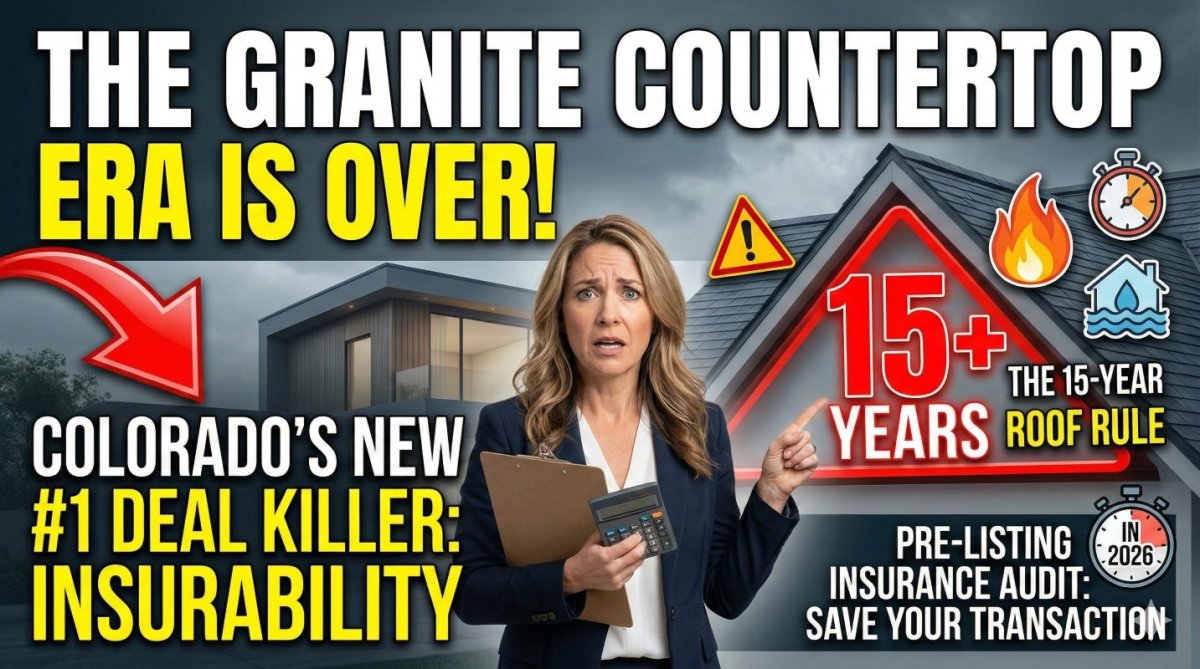
The roof isn't leaking. It has no hail damage. But it is 18 years old. In 2022, that roof was "fine." In 2026, that roof is a deal-killer. The buyer's lender requires insurance. The insurance carrier requires a roof under 15 years old. The buyer has no cash to replace it. The deal dies.
This is not an isolated incident. This is the defining friction point of the 2026 Colorado real estate market.
Part 1: The Anatomy of the Insurance Crisis
To navigate this market, you must understand why this is happening. It isn't arbitrary; it is actuarial.
1. The "Hail Belt" Reality
Colorado has consistently ranked in the top 3 states for hail claims for a decade. Insurance carriers have bled billions in replacement costs. In response, they have stopped being passive risk-takers and started becoming aggressive risk-managers.
2. The Shift to ACV (Actual Cash Value)
Historically, homeowners enjoyed "Replacement Cost Value" (RCV) policies. If a windstorm damaged an old roof, the insurance bought a brand new one. In 2026, most major carriers have shifted roofs older than 10-15 years to Actual Cash Value (ACV) policies.
The Trap: Lenders hate ACV policies on roofs. They often demand RCV coverage to protect the asset. If the carrier won't offer RCV because of age, and the lender won't accept ACV, the buyer is trapped in a coverage gap.
3. The DTI Breaker
Even if a carrier will write the policy, the price is the second killer. Insurance premiums in Colorado have risen 40-60% since 2023. A premium that used to be $150/month is now $350/month.
For a buyer on the edge of qualifying, that extra $200/month destroys their DTI ratio. They literally cannot borrow the money because the insurance is too expensive. The house effectively becomes "financially obsolete" for that buyer pool.
Part 2: The New Asset Class — "The Uninsurable Property"
As agents, we are used to categorizing homes as "Turnkey" or "Fixer-Upper." We need to add a third, more dangerous category: "The Uninsurable."
An Uninsurable Property isn't necessarily a dump. It could be a pristine, updated home with a quartz kitchen and new floors. But if it has one of the following "Red Flags," it is toxic to a financed deal:
- Roof Age > 15 Years (Asphalt): The automatic trigger for non-renewal.
- Wood Shake Shingles: Basically uninsurable in the entire state due to fire risk.
- Wildfire Zone Score: Properties in the "Red Zone" (foothills/interface) are being dropped by major carriers en masse.
- Wiring/Plumbing: Aluminum wiring or galvanized plumbing are instant hard stops.
Why TimeToSell.AI Matters Here
Most agents don't find out a home is uninsurable until the buyer's insurance broker tells them. That is too late. You need to know before you knock on the door.
Using TimeToSell.AI's "Risk Profile" signals, you can filter your farm area for:
- Property Age: Homes built between 1995-2005 (prime candidates for original or first-replacement roofs reaching end-of-life).
- Permit History: Has a roof permit been pulled in the last 15 years? If not, that is a Red Flag lead.
- Owner Financials: High Equity owners are the only ones who can afford to fix this problem.
Part 3: The Pre-Listing Insurance Audit (Your New Standard of Practice)
In 2026, listing a home without auditing its insurability is professional negligence. Before you sign the Listing Agreement, you must run the Pre-Listing Insurance Audit.
Step 1: The C.L.U.E. Report
Ask the seller to order their C.L.U.E. (Comprehensive Loss Underwriting Exchange) report. This shows every claim filed on the property in the last 7 years. If there was a "water damage" claim 3 years ago that wasn't properly remediated, you need to know. A home with multiple recent claims is a "High Risk" asset to carriers.
Step 2: The Roof Certification
Do not rely on the seller saying, "The roof looks fine." Get a licensed roofer to inspect it. Specifically, ask for a "5-Year Certification." If a roofer won't certify it for 5 years, an insurance company won't write it.
Step 3: The "Ghost Quote"
This is the pro move. Call your preferred insurance broker before you list. Give them the address and property specs. Ask:
"If I bring a buyer with a 720 credit score, can you write this home? And what will the annual premium be?"
If the broker says, "I can't touch that roof," or "The premium will be $6,000/year," you have a problem. But knowing it now gives you power.
Part 4: The Strategy — Cash vs. Cure
Once you identify an "Uninsurable" listing, you must present the seller with the "Two Paths" strategy. This is a hard conversation, but it is the only way to get the home sold.
Path A: The Cure (Replace the Roof)
If the seller has equity (which TimeToSell.AI can verify), this is the highest ROI move they can make.
The Math: A new roof might cost $20,000. But trying to sell a home with a 20-year-old roof might require a $50,000 price cut to attract a cash buyer. By spending $20k, they save $30k in equity.
The Marketing Angle: When the roof is replaced, you market the home as "Insurance Optimized."
"New Class-4 Impact Resistant Roof! Qualifies for 25% Insurance Discount!"
In a payment-sensitive market, telling a buyer you just lowered their monthly insurance bill by $100 is better than a granite countertop.
Path B: The Cash Exit (Sell As-Is)
If the seller does not have the cash to replace the roof, or refuses to do so, you must change your target buyer. Do not market to FHA or low-down-payment buyers. They cannot close.
You must target Cash Investors or Self-Insured Entities. You must price the home aggressively below market value to account for the risk they are taking. This is the "Liquidity Discount."
The Script: "Mr. Seller, without a new roof, this home cannot be financed by 90% of buyers. We have to list it as an 'Investor Special' or 'Cash Only' transaction. This will require a price adjustment of roughly 15% below market value. Or, we can fix the roof and sell for full retail. Which path do you prefer?"
Part 5: Marketing Insurability as the Ultimate Luxury
In 2026, "Boring is Beautiful." Buyers are terrified of hidden costs. They are scared of their mortgage payment going up next year because of an insurance hike.
Your marketing materials needs to scream STABILITY.
The "Insurability" Rider
Create a one-sheet document for your open house:
- Roof: 2025 Installation (Class 4 Impact Resistant).
- Plumbing: PEX (No Polybutylene).
- Wiring: Copper (No Aluminum).
- Estimated Insurance: $180/mo (Quote attached).
Handing this to a buyer is like handing them gold. It removes the fear of the unknown. It proves the monthly payment is stable. It differentiates your listing from the pretty-but-risky flip down the street.
Conclusion: The Agent as Risk Manager
The era of the "Door Opener" agent is dead. In the complex landscape of 2026, with insurance cliffs and HOA spikes, the agent must be a Risk Manager.
By using TimeToSell.AI to identify these risks early, you protect your time, you protect your seller's equity, and you ensure your closing rate stays high while others watch their deals crumble.
Don't let a roof kill your commission. Audit the risk, manage the cure, and close the deal.
Audit Your Listings Now: Log in to TimeToSell.AI to check the permit history and risk profile of your current leads.