
Most agents treat market data as background context. They read the latest absorption numbers, glance at median days on market, and then return to the same prospecting lists they used last quarter. A smaller group treats data as the starting point of a pipeline. They use public signals to identify where pressure is building, then convert the most relevant of those signals into private, ranked access before the rest of the market notices.
That is the practical path from free Market Intelligence to private inventory. It is already available to Colorado agents today, and it will become more valuable as the locked-in effect continues to shape turnover through 2027–2029.
This article explains how the free daily and weekly Market Intelligence reports function as a statewide radar, how exclusive Territory Farm seats convert the highest-value signals into a private Priority List, and how the combination creates an off-market pipeline that traditional farming and shared leads cannot match.
What the Free Market Intelligence Actually Delivers
Every day, TimeToSell publishes a free Colorado Market Intelligence report. Weekly, monthly, and quarterly summaries provide longer-horizon views. These reports are not generic market commentary. They surface specific, high-severity signals: geographic clusters of listing stress, shifts in dominant seller profiles, X&W and reattempt patterns, and other indicators that historically precede elevated turnover.
The reports are deliberately public. The goal is to raise the quality of market awareness across the entire Colorado agent and lender community. Anyone can read them. The differentiation begins when an agent decides to act on a signal inside a specific community.
You can access the full archive and the latest reports at timetosell.ai/market-intelligence. The machine-readable JSON and Markdown versions are also available for agents and firms that want to integrate the signals into their own systems.
From Public Signal to Private Priority List
A public signal tells you that a particular geography or profile is heating up. It does not give you the ranked list of the individual owners most likely to list, nor does it protect you from every other agent who read the same report. That is the role of the exclusive Territory Farm seat.
When an agent claims an open community seat, they become the only active agent receiving the ranked Priority List for that neighborhood while the seat remains active. The list is ordered by TimeToSell score and enriched with the seller profile that explains the underlying drivers (see the full taxonomy on Seller Profiles). Full property intelligence is one click away. Optional AI Manager nurture can run under the agent’s name with proper consent.
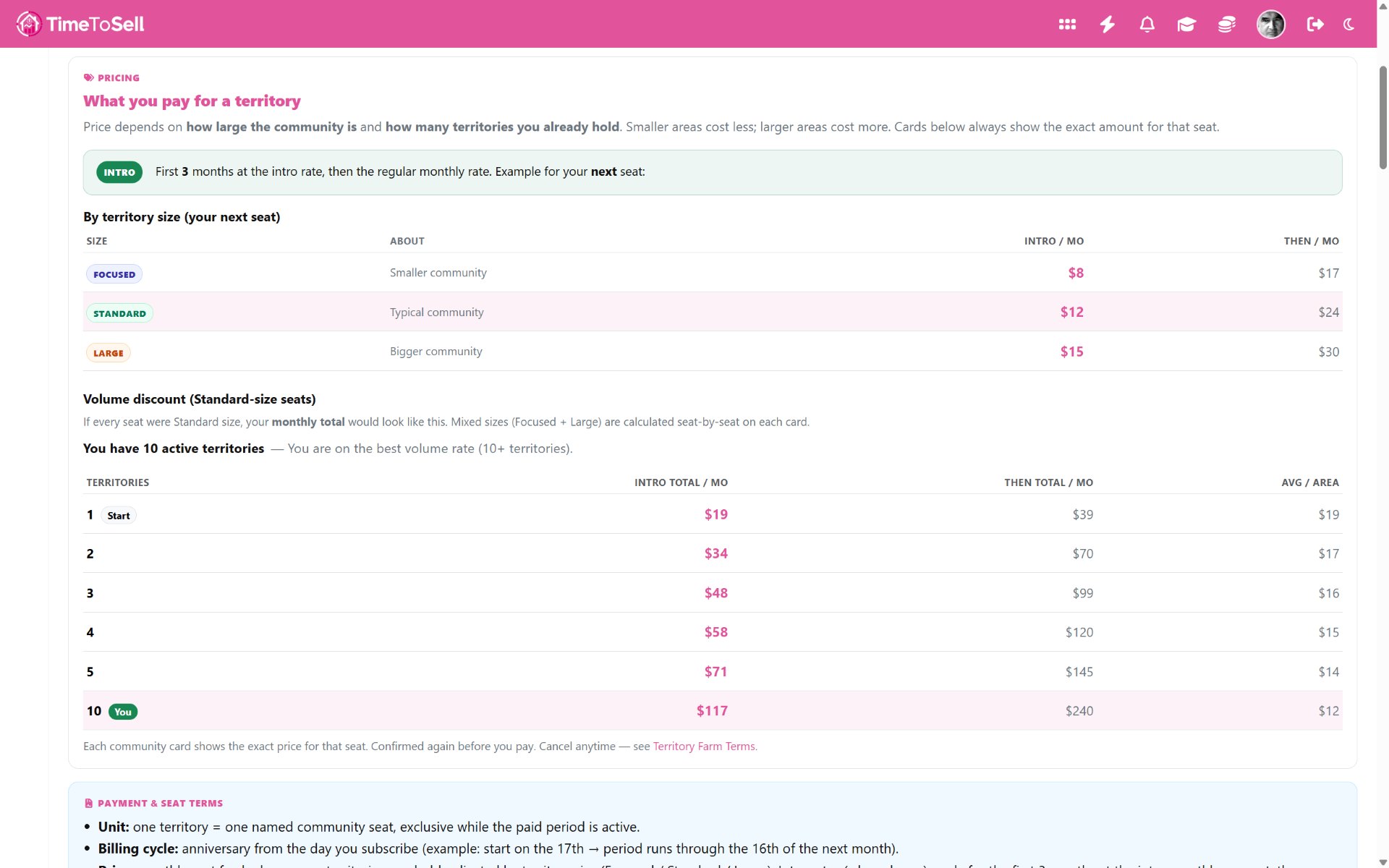
The economic model is deliberately simple: monthly wallet-based billing, cancel anytime, missed renewal returns the seat to the open pool. Current intro pricing starts at $19 per month for the first three months on a single community. Details and current open seats are at Territory Farms for Agents and Browse Open Slots.
The public Market Intelligence reports and the private Priority Lists are powered by the same underlying models. The free layer surfaces the trends. The exclusive layer converts the most relevant trends into actionable, protected inventory for one agent.
Why This Matters More in 2027–2029
As long as the locked-in effect continues to suppress overall turnover, the absolute number of motivated sellers remains constrained. In that environment, competing for the same already-visible listings becomes a lower-return activity. The higher-return activity is identifying the next wave of motivated owners before they raise their hands.
Public Market Intelligence provides the early warning. Exclusive seats provide the conversion mechanism. Agents who only read the reports gain awareness. Agents who convert the highest-severity signals into exclusive seats gain a private pipeline.
This is especially powerful when combined with the buyer-capacity side of the model. Knowing that a set of owners is likely to list is valuable. Knowing what the local buyer pool can support at different price and concession levels allows the agent to price and negotiate more effectively when those owners do decide to move. See the companion discussion of Owner Profiles and capacity scoring.
A Practical Weekly Workflow
- Read the latest daily and weekly Market Intelligence reports. Note the highest-severity geographic and profile signals that overlap with your core markets or the markets you want to enter.
- Cross-reference those signals against the seller profiles most likely to respond under the current rate path (see the detailed mapping in the companion articles on the locked-in effect and interest-rate scenarios).
- For the communities where the signal is strongest and an open seat exists, evaluate claiming a Territory Farm. The goal is not to claim every open seat; it is to claim the seats where the public signal and your own local knowledge align.
- Once a seat is active, work the ranked Priority List with profile-matched outreach. The Agent Playbook provides practical sequences for the major profiles.
- Monitor subsequent Market Intelligence reports for confirmation or shifts in the same geographies. Adjust the priority of your seats accordingly.
This workflow turns a free public resource into a private competitive advantage without requiring the agent to become a data scientist.
Accuracy and Trust
Predictive systems are only as useful as their track record. TimeToSell publishes the performance of its Tier-1 predictions (scores 86–99). Historically, approximately 80% of those high-score properties list within 12 months. The methodology and the latest figures are available on the Accuracy page. Agents should treat any predictive score as a probability, not a guarantee, and should always combine it with local knowledge and direct owner conversations.
The Longer Horizon
By 2028–2029 the locked-in cohort will have aged further and life-cycle pressure will have increased for a large share of owners. The cumulative effect will produce more turnover than a pure rate model would suggest. The agents who spent the intervening years converting public Market Intelligence into private ranked relationships inside specific communities will be positioned to capture that volume. The agents who continued to treat market data as background noise will still be competing for the same thin set of already-motivated sellers.
The free reports will continue to be published for everyone. The exclusive seats will continue to convert the highest-value signals into private pipelines for the agents who claim them. The only question is which agents will make the conversion while the seats are still available.