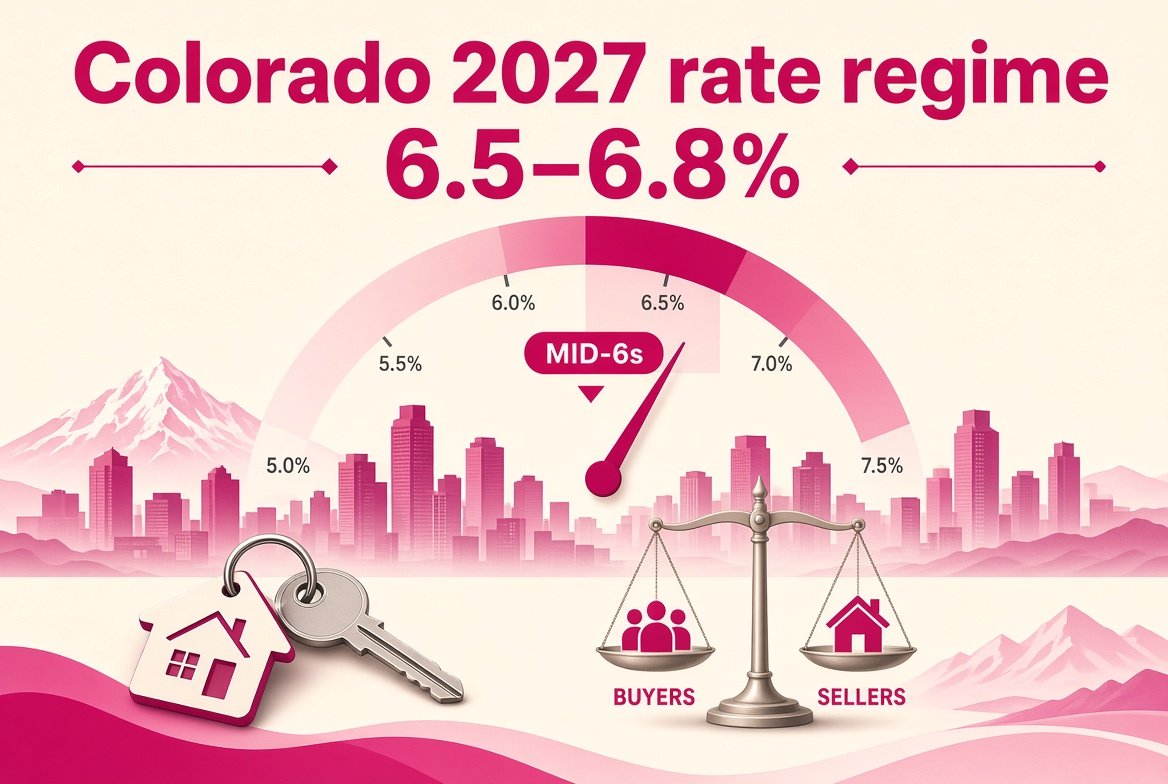

Executive Summary: The "Spring Rush" of 2026 has arrived, but it looks nothing like the frenzies of the early 2020s. For the past two years, the real estate industry held its breath, waiting for mortgage rates to drop back to 4%. In February 2026, we must accept the hard truth: that isn't happening. The market has recalibrated to a new baseline in the mid-6% range.
This shift has fundamentally altered the psychology of the Colorado homeowner. The discretionary seller—the one who just "wants a change" or "would like a bigger yard"—is staying put, anchored by their 3% mortgage. However, inventory is rising. Why? Because the 2026 market belongs entirely to the Non-Discretionary Seller: homeowners driven by life events like high-interest debt consolidation, growing families, and aging in place issues. This comprehensive guide details the psychology of these sellers, the specific data signals that identify them, and the exact playbook agents need to win their business in Spring 2026.
Part 1: The Death of the "Wait and See" Strategy
For the last 24 months, real estate agents in Denver, Colorado Springs, and Fort Collins have been having the same conversation with prospective sellers:
"We want to move, but we are going to wait until rates come down a bit more."
In 2026, that conversation is dead. The Federal Reserve has signaled a "higher for longer" stability. The volatility is gone, but so is the cheap money. This stability is actually a good thing for the market, but it requires a massive pivot in how agents prospect.
The Discretionary vs. Non-Discretionary Divide
To succeed this spring, you must stop marketing to the wrong people. We can divide every homeowner in Colorado into two buckets:
1. The Discretionary Seller (The "Want" Mover)
This owner has a 2.8% mortgage rate. They have $300,000 in equity. They like their home, but they don't love it. In a normal market, they would move up to a nicer neighborhood. In 2026, they are mathematically paralyzed. To move laterally (to a house of the same price), their monthly payment would double. You cannot script your way around this math. If you are sending "Just Sold" postcards to these people, you are setting money on fire.
2. The Non-Discretionary Seller (The "Must" Mover)
This owner also has a 2.8% mortgage. But they also have a problem that the house cannot solve, or a problem that the house is causing. Their motivation isn't financial optimization; it is life necessity.
- They just had twins and are in a 2-bedroom condo (Density).
- They are drowning in $40,000 of credit card debt at 22% interest (Debt).
- They can no longer walk up the stairs to the master bedroom (Physical).
- They are getting divorced or relocating for a job (Disruption).
The Thesis for 2026: The pain of the life event eventually exceeds the pleasure of the low interest rate. Your job as an agent is not to convince people to sell; it is to use data to identify the people who already need to sell, and then present yourself as the solution to their problem.
Part 2: The Three Signals of the 2026 Market
Using the TimeToSell.AI predictive engine, we have isolated three specific data patterns that are correlating with new listings in Q1 2026. These are the "Invisible Sellers" who will drive your volume this spring.
Signal #1: The HELOC Squeeze (The Financial Reset)
This is the most powerful signal in the current market. While the headlines focus on the 3% primary mortgage, they ignore the "Second Lien" crisis.
In 2022 and 2023, as inflation rose, many Colorado homeowners didn't sell. Instead, they took out Home Equity Lines of Credit (HELOCs) to fund renovations, pay for weddings, or cover rising living costs. Unlike primary mortgages, these are variable-rate loans. Many of these HELOCs have reset or are now sitting at 9%, 10%, or even 11% interest.
The Math of the Squeeze
Consider a typical homeowner in Aurora:
- Primary Mortgage: $400k at 3% = $1,686/mo (P&I).
- HELOC: $100k at 10% = $833/mo (Interest Only).
- Credit Cards/Auto Loans: $1,500/mo.
- Total Monthly Debt Service: $4,019.
This homeowner feels "house rich" (they have equity) but "cash poor." They are drowning in monthly payments.
The "Financial Reset" Solution
This is where the agent becomes a wealth advisor. You approach this seller not with a "Free Home Valuation," but with a "Net Worth Recovery Plan."
The pitch is simple math: "Mr. Seller, you have $250,000 in equity. If we sell your home today, we can pay off the mortgage, the HELOC, and the credit cards. You can take the remaining $150,000 and put 40% down on a slightly smaller, more affordable home (or townhome)."
Even though the new mortgage rate is 6.5%, the loan amount is so much smaller—and the other debts are gone—that their total monthly obligation drops from $4,019 to $2,000. You have saved them $2,000 a month by selling. That is a winning value proposition.
How to find them in TimeToSell.AI: Filter for properties with High Estimated Equity + 10+ Year Tenure + High Estimated Consumer Debt Load signals.
Signal #2: The "Forced Upgrade" (The Density Crisis)
Demographics are destiny. In 2018 and 2019, millennials flocked to Denver and bought starter homes—mostly 2-bedroom bungalows or townhomes. It is now 2026. Those couples who bought with a dog now have a 5-year-old and a 3-year-old.
We call this the "7-Year Itch." Historically, homeowners move every 7-10 years. We are hitting a massive wave of maturity for the 2018/2019 vintage of mortgages.
A 3% mortgage is an incredible financial asset, but it cannot add a bedroom. It cannot create a backyard. For these families, the "density friction"—sharing one bathroom, toys in the living room, no home office—has become unbearable.
The "Bridge" Solution
These sellers are terrified of two things: 1. Giving up their rate. 2. Becoming homeless (selling before they buy).
Your strategy here is the "Recast and Bridge." You need to show them how to leverage their massive equity gains from the last 7 years. By using bridge financing or "Buy Before You Sell" programs (which are becoming standard in 2026), they can secure the new family home first.
More importantly, you can show them how a large down payment (from their equity) acts as a "rate buydown." If they put 50% down on the new house, their monthly payment at 6.5% might be surprisingly close to what they would pay with a smaller down payment at 4%.
How to find them in TimeToSell.AI: Filter for < 2,000 Sq Ft + 3+ Occupants (Census data) + 6-9 Years Ownership.
Signal #3: The Silver Tsunami (The Physical Mismatch)
Economists have predicted the "Silver Tsunami"—Baby Boomers selling off inventory—for a decade. It was delayed by COVID and low rates, but in 2026, biology is winning. The youngest Boomers are now in their 60s; the oldest are hitting 80.
In Colorado, many seniors live in multi-story homes in suburbs like Highlands Ranch, Littleton, and Briargate (Springs). These homes have stairs, large yards to mow, and driveways to shovel. In 2026, "Aging in Place" is becoming "Trapped in Place."
This seller is not motivated by money. They are likely mortgage-free or have very low balances. They are motivated by Logistics and Fear. They are afraid of the physical act of moving. They look at 30 years of accumulated "stuff" in the basement and get paralyzed.
The "Concierge" Solution
To win this listing, you cannot be a salesperson; you must be a Project Manager. Your value proposition is the "One-Trip Move."
Your pitch: "Mrs. Seller, you don't need to clean the basement. You don't need to paint. You identify the items you want to take to the new condo near your grandkids, and my team handles the rest. We coordinate the estate sale, the donation hauling, the cleaning, and the repairs. You hand us the keys, and we hand you a check."
This segment controls the highest quality inventory in the state (4-bedroom, well-maintained family homes). Unlocking this inventory is the key to a massive 2026.
How to find them in TimeToSell.AI: Filter for Owner Age 70+ + 2-Story Property + 20+ Years Tenure.
Part 3: The 90-Day Execution Plan
Knowing who to target is half the battle. Knowing how to execute is the rest. Here is your 90-day roadmap to dominate the Spring 2026 market.
February: The Audit Phase
February is for data gathering. You are not cold calling; you are building your "Hit List."
- Log into TimeToSell.AI: Run the three filters mentioned above (Debt, Density, Physical Mismatch).
- Build Your "Top 50": Identify the 50 homes in your farm that have the highest propensity score (80+).
- The "Audit" Drop: Send a high-value mailer or door drop.
For Debt Signals: "The 2026 Equity-Debt Swap: A Guide to Lowering Monthly Payments."
For Seniors: "The Downsizing Checklist: How to Move Without Lifting a Box."
March: The Conversation Phase
In March, the "Spring Itch" starts. The weather warms up, and homeowners start looking at their yards with dread or their bills with anxiety. This is when you start your calls.
The Script Flip:
OLD WAY: "Are you thinking of selling?"
NEW WAY: "I'm calling because I'm doing an annual Equity Review for long-term owners in [Neighborhood]. I noticed you've been there for [X] years. Many of my clients in your position are looking at how to deploy that equity into a higher-yielding asset or a more comfortable lifestyle. Have you looked at your 'Net Worth' number recently?"
You are selling the result of the sale (Freedom, Cash Flow, Comfort), not the process of the sale.
April: The Listing Phase
If you execute in Feb and March, April is when you sign paperwork. By targeting Non-Discretionary sellers, you are building a pipeline that is immune to interest rate fluctuations. If rates go up to 7%, the "HELOC Squeeze" seller still needs to sell. If rates drop to 6%, the "Forced Upgrade" seller is even more motivated.
Conclusion: Be The Signal, Not The Noise
The agent who blasts "Just Sold" cards to the entire zip code is playing a lottery. They are hoping to catch a random discretionary seller at the exact moment they decide to move.
The Modern Agent uses intelligence. By using TimeToSell.AI to identify the life events driving the market, you are no longer prospecting; you are diagnosing. You are finding the people who need you most, right when they need you.
The Spring of 2026 is not about waiting for the market to come to you. It is about going to the market with a laser-guided solution. The inventory is there, hiding in plain sight behind high equity and high motivation. Go find it.
Ready to build your Spring Pipeline? Log in to TimeToSell.AI to access your predictive farm today.