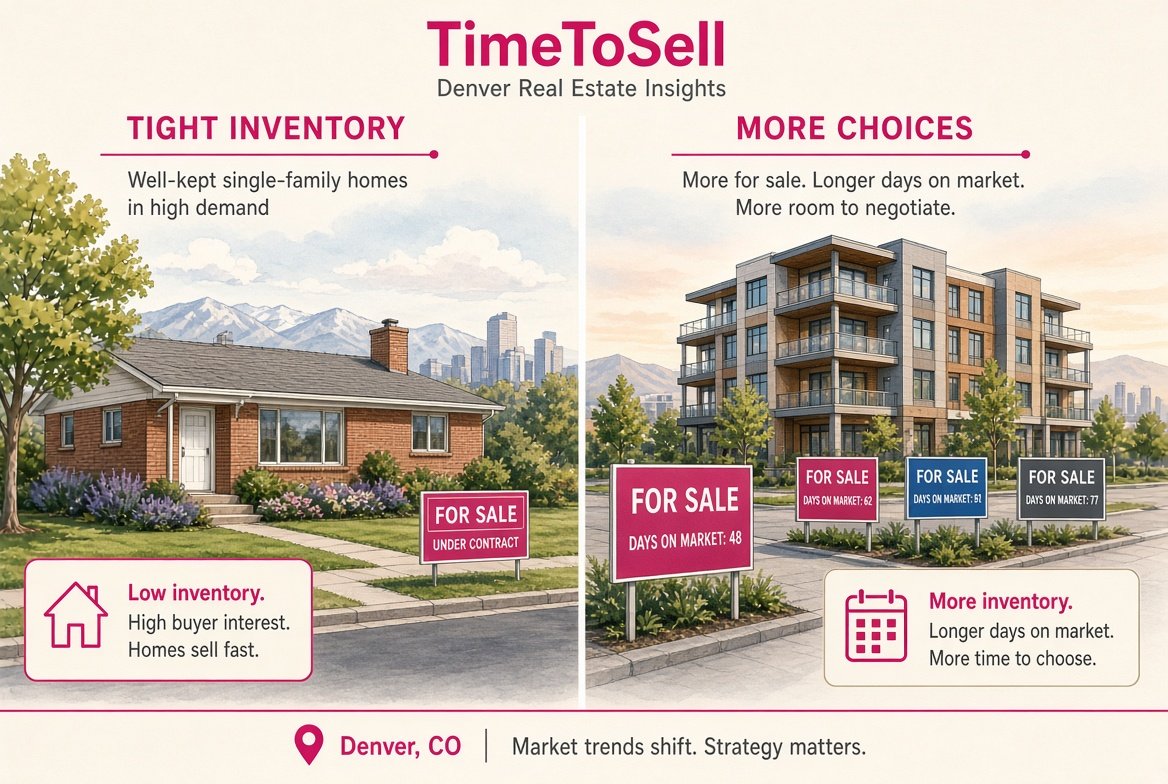

Colorado’s housing market has spent the better part of four years living inside a single powerful force: the locked-in effect. Homeowners who refinanced or purchased between 2020 and early 2022 at rates in the 2.5–3.5% range now sit on mortgages that feel almost free by historical standards. Moving requires them to trade that rate for whatever the market is offering in 2026–2028. For many, that trade is still too expensive.
Yet markets do not stay frozen forever. By 2027 and 2028 the locked-in effect will begin to fracture in uneven, predictable ways. The agents who understand which owner profiles break first — and which remain stuck — will control a disproportionate share of the listings that do appear. This is not speculation. It is the logical extension of interest-rate path dependency, equity positions, and life-cycle pressure already visible in today’s data.
The Current Locked-In Reality (2026 Baseline)
As of mid-2026, a substantial share of Colorado’s owner-occupied stock still carries rates below 4%. In many suburban Denver, Boulder County, and Northern Colorado neighborhoods, that share exceeds 40–50% of recent sales that have not yet turned over. These owners are not irrational. The monthly payment difference between their current rate and a new 30-year mortgage at 5.5–6.5% can easily exceed $800–1,200 on a typical $550,000–$750,000 home. For a dual-income household already managing childcare, student loans, or aging parents, that is a meaningful lifestyle tax.
The result is suppressed turnover. Inventory has recovered from the extreme lows of 2021–2022, but it has not returned to pre-pandemic norms in many price bands. Days on market have lengthened selectively. Price reductions appear earlier and more frequently in certain segments. Yet the overall market still feels constrained because the largest cohort of potential sellers remains on the sidelines.
TimeToSell’s free daily Market Intelligence reports have been tracking the geographic and profile-level pressure points for months. The signals are not uniform. Some ZIP codes and some owner archetypes are already showing elevated listing propensity even while rates remain elevated. Others show almost no movement. That divergence is the key to 2027–2028.
Three Paths for Rates and What Each Unlocks
No one can forecast the Federal Reserve’s exact path with certainty. What we can do is map the most plausible scenarios and the seller profiles that respond under each.
Scenario A — Gradual normalization (most likely base case)
The Fed continues a measured path. Mortgage rates drift into the mid-to-high 5% range by late 2027 and settle near 5–5.5% by 2028. In this environment the pure rate-driven sellers stay mostly locked. The profiles that move are those for whom life-cycle or balance-sheet pressure outweighs the rate penalty: downsizers whose children have left, households facing a forced relocation for work or family, and owners with significant equity who can absorb the payment increase because their next house is smaller or they are moving to a lower-cost state.
Scenario B — Faster easing
Inflation cools more rapidly or growth slows enough that rates fall into the low 5% or even high 4% range by 2027. The locked-in effect softens across a broader set of owners. Trade-up buyers reappear in force. Investors who have been waiting for a more favorable cost of capital begin rotating. The volume of listings rises more evenly across profiles.
Scenario C — Sticky higher rates
Rates remain in the 6%+ range through 2027. Turnover stays structurally lower. The market becomes even more selective. Only the highest-pressure profiles list: life-event forced sellers, insurance or HOA-driven exits, and owners whose equity has been eroded by localized price corrections or deferred maintenance. In this world, predictive tools become more valuable, not less, because the absolute number of motivated sellers shrinks while competition for those listings intensifies.
Agents who plan only for Scenario A will be surprised by either B or C. The more robust approach is to treat the locked-in effect as a spectrum of owner motivations rather than a binary “will sell / will not sell.”
Which Seller Profiles Break First
Not every locked-in owner is equally locked. TimeToSell’s proprietary seller profiles (see the full taxonomy on our Seller Profiles page) capture the combination of equity, life stage, leverage, and external pressure that drives listing decisions. The profiles most likely to unlock between now and 2028 are:
- Trapped Equity Downsizers — Long-tenured owners in larger homes whose children have left. They often have substantial equity and lower remaining mortgage balances. The rate penalty is real, but the lifestyle gain of a smaller, lower-maintenance property can outweigh it, especially if they can structure a rate buydown or accept a shorter remaining term on the next purchase.
- Life-Event Executors — Divorce, death, job relocation, or health-driven moves. These owners do not have the luxury of waiting for rates. Their listing propensity is less rate-sensitive and more event-driven. Predictive models that incorporate life-event proxies (and the free Market Intelligence signals that surface geographic clusters of these events) give agents an early window.
- HELOC Squeeze / Cash-Flow Stressed — Owners who extracted equity during the low-rate years and now face higher variable HELOC rates or reduced free cash flow. As rates stay elevated, some of these households will choose to sell rather than continue servicing both the first mortgage and the second lien.
- Insurance and Climate-Forced Exits — In certain Colorado mountain and wildfire-adjacent communities, insurance non-renewal or steep premium increases are already creating listing pressure independent of the mortgage rate. This is a structural trend that will intensify through 2027–2029.
Conversely, the profiles most likely to remain locked are younger trade-up families with high remaining balances and limited equity cushion, and pure investors who can still cash-flow at current rents and are waiting for a clearer rate path.
For a deeper look at how these profiles are constructed and how they appear in daily signals, see our Seller Profiles documentation and the ongoing Market Intelligence series.
The 2027–2028 Agent Advantage
In a market still shaped by the locked-in effect, the agents who win will not be those who simply farm more doors or buy more shared leads. They will be the agents who can identify, months in advance, which specific owners inside a neighborhood are most likely to list — and why.
That is the core of predictive seller intelligence. TimeToSell’s model scores every Colorado property for sell propensity and attaches a profile that explains the underlying drivers. When combined with exclusive community seats (one active agent per released neighborhood), the agent receives a ranked Priority List rather than a raw list of addresses. The difference in conversion and time efficiency is substantial.
You can explore how exclusive seats work on the Territory Farms for Agents page and see current open communities at Browse Open Slots. The free daily and weekly Market Intelligence reports remain available to everyone; they surface the highest-severity signals statewide so agents can decide where to focus their exclusive seats.
Practical Next Steps for Colorado Agents
- Read the latest Market Intelligence reports for your core markets. Note which profiles and geographies are already showing elevated pressure.
- Map those signals against the seller profiles most likely to break under the rate scenarios above.
- If you want to move from public signals to a private, ranked pipeline inside a specific community, review the Territory Farm model and current open seats.
- Use the Agent Playbook for practical outreach frameworks that match each profile.
The locked-in effect will not vanish overnight. It will erode unevenly across profiles and geographies through 2027 and 2028. Agents who treat it as a uniform barrier will continue to compete for the same thin set of already-motivated sellers. Agents who treat it as a differentiated, predictable process will build pipelines before the yard signs appear.
That is the shift from reactive farming to predictive inventory creation. The tools exist. The data is already flowing. The question is which agents will use it before the rest of the market catches up.