
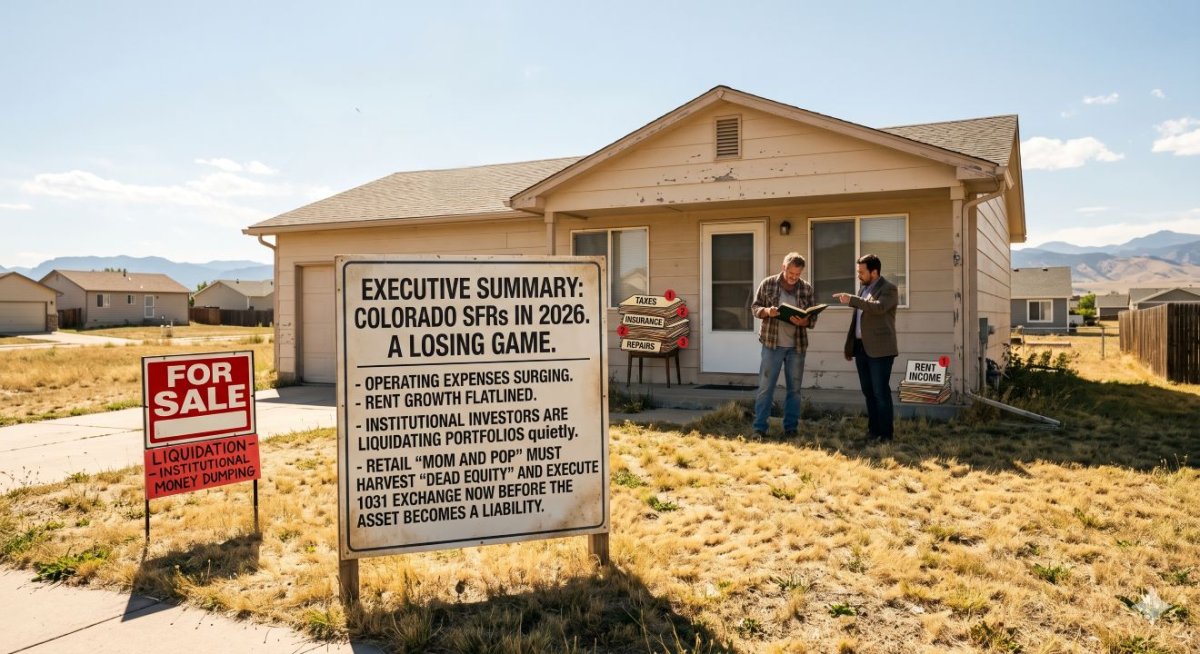
Executive Summary: If you are holding a Single-Family Rental (SFR) in Colorado in the summer of 2026, you are likely playing a losing game. The mathematical realities that made SFRs the darling of the investment world from 2012 to 2021 have completely inverted. Operating expenses are surging while rent growth has flatlined. Institutional investors and iBuyers like Opendoor are quietly dumping their SFR portfolios. This stark, analytical guide explains why retail "Mom and Pop" investors must follow the institutional money out the door, harvest their "Dead Equity," and execute a 1031 Exchange before their asset becomes a liability.
The Institutional Sell-Off
Watch what the smart money does, not what it says. Over the past 18 months, Wall Street-backed SFR funds and algorithmic iBuyers like Opendoor have been aggressively trimming their residential portfolios. They aren't doing this because they need the cash; they are doing this because the Cap Rates have collapsed.
The institutions realize that holding a $600,000 single-family home in Thornton that rents for $2,800 a month is terrible capital allocation when you factor in 2026 operating expenses. If the algorithms are dumping SFRs, why are you still holding yours?
The Collapse of Cash Flow
Let's conduct a forensic analysis of a standard Colorado rental property. The problem isn't your mortgage rate—it's the uncontrollable variables.
- The Insurance Gouge: Commercial dwelling policies for non-owner-occupied properties have seen historic rate hikes due to regional hail and fire risks. This is a pure, unrecoverable margin reduction.
- The Property Tax Reset: Colorado property taxes have adjusted to reflect peak pandemic valuations. The days of low holding costs are permanently over.
- Maintenance Inflation: A roof replacement that cost $12,000 in 2019 now costs $22,000. HVAC replacements have nearly doubled. One major CapEx event wipes out three years of your rental cash flow.
- Stagnant Rents: With thousands of new luxury apartment units delivered across Denver and the Front Range in 2024 and 2025, rent growth has hit a wall. You cannot pass these increased operating costs down to the tenant.
The "Dead Equity" Trap
Here is the most painful truth for the Tired Landlord: You are likely sitting on $250,000 to $400,000 of equity. But because your net cash flow (after taxes, insurance, and maintenance reserves) has shrunk to roughly $200 a month, your Return on Equity (ROE) is less than 1%.
That is Dead Equity. You could literally sell the house, put the cash in a basic Treasury Bill, and make 4x the yield with absolutely zero risk of a tenant destroying your plumbing.
The Professional Playbook: The 1031 Rotation
You should not sell your rental to pay capital gains taxes. You should execute a 1031 Exchange.
Using platforms like TimeToSell.AI, elite agents are helping investors identify the exact moment their SFR hits peak "Dead Equity." The agent brokers an off-market sale of the rental (often to a first-time homebuyer who is desperate for inventory), and simultaneously identifies a replacement asset.
Where is the Smart Money Going?
Investors are moving out of high-maintenance SFRs and rotating that tax-deferred capital into:
- Triple-Net (NNN) Commercial Leases: Where the tenant pays the taxes, insurance, and maintenance.
- Delaware Statutory Trusts (DSTs): Fractional ownership in institutional-grade assets (like medical centers) where management is 100% passive.
- Value-Add Multi-Family: Trading one house for a 4-plex in a secondary market with higher cap rates.
Conclusion: Stop Managing Toilets
The 2026 market punishes laziness. Holding a single-family rental just because "real estate always goes up" is a lazy, dangerous strategy. Audit your ROE today. If your equity is dead, follow the institutions to the exit and rotate your capital into an asset that actually serves your wealth goals.
Are You Holding Dead Equity? Access your confidential TimeToSell.AI dashboard to analyze your property's performance and model a 1031 Exchange scenario today.